Introduction

Bioluminescence, the phenomenon of light production in living organisms, has been recorded as far back as 1000 BC in the Chinese Book of Odes. Such figures as Pliny the Elder and Plato marvelled at the light displays in nature.
In particular fireflies and glow-worms have been a part of ancient folklore and legend for thousands of years. The early Mayan civilisation associated the firefly with smoking cigars and often adorned their art with firefly images. In Japan the light of a firefly is regarded as a symbol of the souls of the recently deceased, the hitodama.
Bioluminescence even formed the subject of some of the first scientific experiments. In 1672 the English scientist Robert Boyle, during experiments on glow-worms, fungi and bacteria, established some of the basic principles of bioluminescent reactions, it is a cold light; it can be chemically inhibited; and the light reaction is dependent upon air.
Bioluminescence in insects
Luminescent organisms are predominantly found in the oceans and bioluminescent bacteria, jellyfish and deep sea fish are just some of the well know examples of light producing animals in the sea. However, luminescence is evident in many terrestrial organisms such as fungi, worms, millipedes, centipedes and most notably in insects.
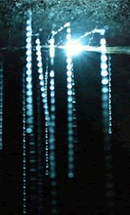
In insects, bioluminescence is not just restricted to beetles but is also evident in the flies (Diptera). The term glow-worm is used to describe the luminescent larvae of certain fungus gnats that belong to the subfamilies Arachnocampinae, Keroplatinae and Macrocerinae of the dipteran family Keroplatidae. They are found in dark, damp places such as caves, on river banks or near streams and dense forests. Their blue-green emissions assist in the capture of prey, usually small winged insects, which are lured by the light towards snares composed of vertical silk threads coated with sticky mucus droplets. Although the details of the bioluminescent mechanism are not yet established, preliminary investigations show no clear parallels between flies and beetles. But probably the most studied of all bioluminescent insects, however, are the beetles.
Bioluminescent Beetles
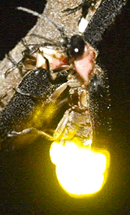
Beetles (Coleoptera) constitute the largest taxonomic group of living organisms. This is reflected in the number of luminescent coleopteran species. Over 2000 species are recorded and many more await discovery. Bioluminescent beetles are predominantly found in the beetle superfamily Elateroidea which contains the three main bioluminescent families; Lampyridae (fireflies and glow-worms), Phengodidae (railroad worms) and Elateridae (click beetles). Two other families, Omalisidae and Staphilinidae are also thought to contain bioluminescent taxa. One further family, the Rhagophalmidae, albeit containing well established bioluminescent members, is controversial in its relationship to the other bioluminescent beetle families.